Thursday, December 20, 2012

Diving in Alexandria: Amphora


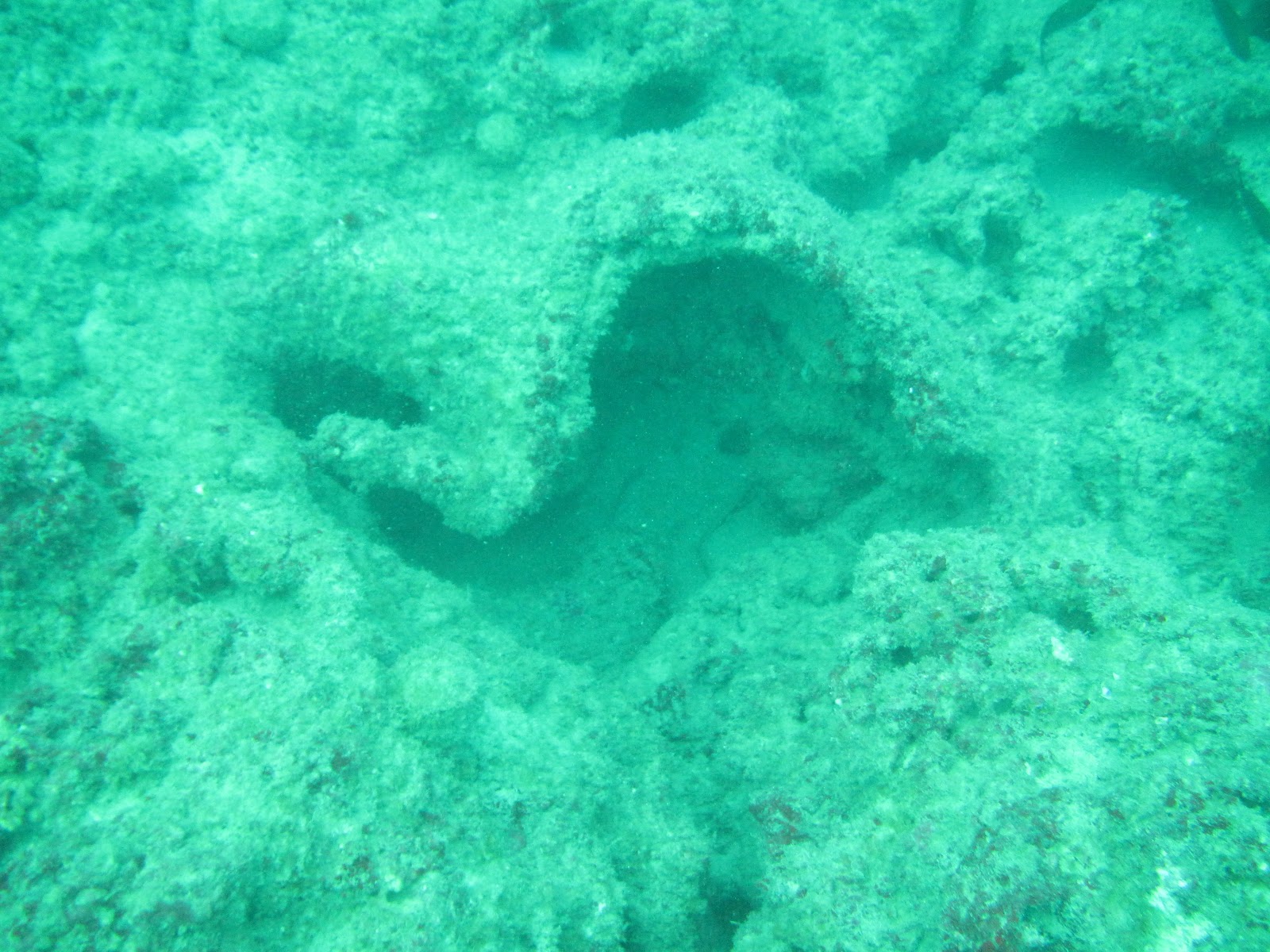
The diving in Alexandria was truly amazing. I got in contact with a local dive center and went diving with them to all of the archaeological dives in the harbor and right outside of Alexandria. My first dive was a bit outside the harbor, where an ancient Greek ship had capsized and dropped amphora all over the seafloor. While most were broken, many were in pretty good shape, and it was really cool to see these artifacts underwater, left scattered where they fell. The ship's huge anchor also remained underwater. This was definitely not my favorite dive in Alexandria, but it is hard to beat giant column bases from a wonder of the ancient world and pieces of sphinxes. Still, this was a really interesting dive. 


The large anchor


Amphora


Amphora


2 Amphora


Amphora


Amphora


Amphora


Amphora


Amphora


Amphora


Amphora


Amphora


Many amphora


Amphora scattered across the seafloor

It is a little overwhelming to see all these amphora just sitting underwater, when I've seen so many displayed in museums. Sure, these are mostly broken, but they're still really interesting cultural heritage, left underwater so only divers can see them. They're not even the main underwater cultural heritage attractions in Alexandria--those would be the lighthouse and city ruins. It's strange to see these just scattered underwater, with many broken apart. However, one needs to consider the sheer number of amphora in the area. There is another region a bit farther away from Alexandria which also had many amphora-filled shipwrecks, leaving the seafloor covered with ancient amphora. Lots of these artifacts have been removed and preserved for museums, but it's not worth the cost to raise up and preserve every amphora in the waters near Alexandria. These amphora make a great diving destination for divers interested in archaeology, but the underwater cultural heritage here is not being particularly protected against the elements or promoted as significant history in the community. 

~Kristine

Fort Qaitbay


Fort Qaitbay is a beautiful fort on the edge of the harbor of Alexandria. While it is mostly empty, the fort itself is very picturesque and has great views of the city. Also, most interestingly to me, the fort is built on the ruins of the Lighthouse of Alexandria.


Alexandria, as seen from a window inside the fort


Fort Qaitbay


Fort Qaitbay


Courtyard of the fort


Side wall of the fort


Front of the fort


When I went there, a guard offered to show me around. While usually people who offer tours want you to pay them, he just wanted to practice his English. I got to see the uses of different rooms, some old cannons, and the secret exit to the sea. There actually is not much to see inside the fort, but the views of the ocean and of Alexandria were beautiful.   


Ceiling of a tower in fort


Floor 


Well


View of Alexandria (and harbor) 


View of Mediterranean 


Courtyard of fort


I also was able to walk along the wall of the fort, so I could see the whole harbor and some of the seaside part of the city.


View of Alexandria and its harbor 

View of Anfoushi neighborhood in Alexandria

Alexandria 


Museum of Alexandria, as seen from upper wall of fort


I loved looking down on the water nearby and knowing that in a few days I would be diving down there to see some of the ruins of the lighthouse!


The water to the right is where there are ruins from
when the Lighthouse of Alexandria toppled over
during an earthquake. 

~Kristine

Taxis


I could not fully explain my experience in Egypt without sharing some of the many taxi stories I have acquired. While there were microbuses to use as public transportation, none ran from my place all the way into the city. So I often ended up using taxicabs to get into Alexandria, and then I walked around once I had arrived in the city. As I mentioned in an earlier post, the taxis in Egypt are not metered, so after hailing a cab, I had to tell the driver where I wanted to go and negotiate a price. The negotiation itself was always interesting, and there were so many cabs that if a driver wouldn’t lower his price, I let him go and hailed another. Sometimes, a local person would offer to help me hail a cab. I never said no to that, since they seemed to magically get a lower price every time for me. Almost every time that a taxi driver smoked, he asked beforehand if I were okay with that (which I was) and offered me a cigarette (which I declined). They also often asked me if the music were okay and checked whether I wanted the windows up or down. I always appreciated their consideration. One driver even stopped for a snack and then offered half of it to me (which I also declined).

I had many little adventures with taxis. A relatively common situation would be that I would say a place, we’d find a price, I’d get in, and five minutes into the ride the driver would try to ask me where I wanted to go again. And of course, he’d ask in Arabic and I couldn’t respond. This first happened during my first weekend in Cairo before going to Alexandria. I wanted to go from my hotel to the train station to buy a ticket to Alexandria for the next day. I walked to the main road, hailed a cab, and told him the name of the train station. He didn’t get the word ‘train,’ but he repeated the station’s name and nodded, so off we went. Then, he started trying to speak to me, clearly trying to figure out where I meant. I realized that the name of the station was a neighborhood, and he didn’t know I wanted to go to the train station. Finally, he pulled over and started talking to a guy on the street. Said guy asked me where I wanted to go in English, I told him, and he explained to the driver. Then, the guy got in the front seat and off we went. We had a nice little conversation, and the guy got out at a bus stop nearby. It turns out that drivers are likely to get two different fares at once if one is on the way to the other. Some also won’t tell me if they don’t fully understand where I want to go. Because of this, many taxi rides were quite adventures. I started figuring out tricks, like asking someone on the street to interpret. In Alexandria, I almost always got dropped off at the Saad Zaghloul Square downtown, and I just walked to wherever I wanted to go from there.

Statue of Saad Zaghloul

Saad Zaghloul Square


I always had to confirm that they had change for my bills before I got in, although some could get change from a store nearby or another driver if necessary. One time, I only had a 200 Egyptian Pound bill with me in Alexandria, and I knew no driver would break a 200. But I had to get home, so I decided to buy a cheap pair of sunglasses, since the man selling them would be willing to break the bill in order to make the sale. My sunglasses were wearing out quickly, so I needed a new pair anyway!

My favorite taxi adventure happened when I had to go to the diving place the first time in Alexandria. I had been given the name, but I couldn’t find it on Google Maps and I had a feeling no taxi driver would know what I meant. I decided to get to the main square and walk into the nearby hotel, so that I could ask the concierge to call a cab, and the English-and-Arabic-speaking concierge could explain where I wanted to go.

Hotel Sofitel Cecil in Alexandria,
a beautiful downtown hotel
with helpful concierges! 


The concierge called a taxi driver who, throughout my whole time in Egypt, was the best English speaking taxi driver I had. The driver and I had a great conversation as we went to the dive center (well, we went to the wrong one, but I called the center and it was right next-door, so no worries). A week later, when at the Library of Alexandria, I tried to go into the building but was told I had to buy a ticket. I turned around and there was the same driver! He was dropping off a British couple staying at that hotel. Apparently, he stays near the main square and often is called by the hotel to transport its guests. So the driver then walked me over to the ticket place, explained about having to check my purse (but to put my money/camera/passport in my pockets to take in), and then said goodbye. He was very helpful, because I had no idea the ticket booth was in a separate building not visible from the main entrance. Flash forward three days, and I was standing on the sidewalk on a road near the main square, and my taxi driver friend walked by! He just said hi and kept going. Finally, on the day I left Alexandria, I walked into the airport and was a bit confused, because you have to go through security in order to get to the ticket counter. Since I hadn’t printed out my ticket, I was worried they wouldn’t let me through. I wandered around a bit trying to find an information desk or something, and there, once again, was the taxi driver, who was dropping someone off at the airport and had walked them in. He pointed out the line and said it was fine to go through with no ticket, and that I could just show my passport and say where I was going. It was so random that in the second-biggest city in Egypt I ran into this driver four separate times. He was always so friendly and helpful—definitely my favorite taxi driver.

Another thing that worried me about the taxis is that they often don’t use their trunks, so I had all my belongings siting on the roof of a few different taxis, held down by some frayed twine (or, in one case, bungee-cord). Because of this, I had visions of my bags falling off and being run over. By the end of my time in Egypt, though, I had adopted a what-will-be-will-be mentality, and stopped stressing about my stuff on the roof.

Finally, what I found most exciting about my taxi adventures was the fact that street laws were very, very lax. I mean, I’ve been in countries with intense traffic and driving before, but never have I been in a car that backed up a one-way ramp with cars coming down it at the same time. This happened twice in Egypt. Also, on the main highway in Alexandria that runs along the water, my driver has had to pass on the right a horse-drawn cart filled with fruit, the hose cantering down the highway in the fast lane. We’ve dodged quite a few people, too. (Conversely, as a pedestrian I’ve dodged quite a few taxis in Egypt).  While at first the fact that there would be five cars across on a three lane road or the intense speed-and-then-stop situations stressed me out, I later learned to just sit back and enjoy the view. The driving might be a little scary, but I never saw car crashes, so it always worked out.

These are just a few of my stories from taxi rides in Egypt. Needless to say, getting to places was never boring for me!

~Kristine

Tuesday, December 18, 2012

Alexandria National Museum


Getting to the Museum


The first place I visited for my project in Egypt was the Alexandria National Museum. Getting to the museum was a bit of an adventure. I decided to take a cab from my apartment, since—with a little bit of haggling—it is relatively cheap to get into the city in a taxi. I told the driver I wanted to go to the Alexandria National Museum, and finally he said, “mouseion?” and I nodded. I figured that since it is called the Alexandria National Museum, it would be the ‘museum’ in the city. Half an hour later, he dropped me off in front of a building covered with scaffolding and with the word ‘MOYZEION’ written across the top in Greek. I tried to explain this was not the right place, and I even showed him the picture in the guide book, but clearly he didn’t understand what I meant and I couldn’t explain where I wanted to go. This was my first adventure into the city, so I did not know the neighborhoods. I got out of the cab, paid, and tried to figure out where I was. I realized quickly that this was the Greco-Roman museum, which was closed for renovations. It was on a map in my guidebook, but the Alexandria National Museum was on a different map, so I couldn’t figure out how to get from one to the other. I wandered until I found a main road and decided to hail a cab to take me to the correct museum, wherever it was. If the driver didn’t know, I would try a different taxi. Thankfully, the first one I hailed had another person in the passenger seat (taxis will often pick up more than one fare at once) who explained to the driver where I wanted to go. When I asked how much he gave me a very, very low number, which made me realize I probably was really close to the museum. However, I paid and let him drop me off right in front of the museum. After that, I knew how the two maps connected! Despite the short period of time of being stranded in Alexandria and not knowing where I was, I successfully made it to the museum.


The Collections


The Alexandria National Museum had an excellent collection. It is housed in an old Italian mansion and organized by different eras in Alexandrian history. In the basement were ancient Egyptian artifacts from the Pharaonic times, on the main floor were Greco-Roman things, and upstairs held sections for Islamic art and other pieces from the past two millennia. Also on the main floor was a collection of submerged antiquities. This room held a few heads of statues, some jewelry, and other small pieces found during some early excavations in the harbor. While the pieces themselves were not the most spectacular from the marine archaeological excavations in Alexandria, I was pleased that these underwater artifacts had their own space in the city’s main historical museum. This shows that Alexandria values its underwater antiquities as an important section of the city’s historic treasures.


Underwater Antiquities Collection 


The room had large pictures from the excavations on the wall. The lighting was darker than in other rooms and had a blue tint to it. By trying to give the room an underwater atmosphere, the space invites visitors to imagine these pieces being discovered and raised. I found this focus on the excavation exciting. Obviously the statue head of a Roman emperor was originally displayed above ground. It only ended up underwater because of an earthquake which submerged part of the ancient city. Other statues in the museum aren’t shown surrounded by the dirt from which they were dug. I was impressed that they were intentionally exposing visitors not only to the history of these antiquities, but also to the process of underwater archaeology.

The rest of the museum was also fascinating, and it was a great history lesson on Alexandria. And don’t worry, getting home was much less of an adventure than finding the museum!

~Kristine

Choosing Alexandria


I suppose I should share why I chose to go to Alexandria in the first place! When researching shipwrecks and submerged ruins when planning my application, I came across Cleopatra’s sunken city. In a series of earthquakes, part of Alexandria sank into the harbor. The Lighthouse of Alexandria, which is one of the Seven Wonders of the Ancient World, and a section of the ancient city  are now submerged in the Mediterranean. While diving these ruins sounded fantastic, I knew I needed to find more than just cool ruins to justify going to Alexandria for my project. Sure, getting to dive is an awesome part of my project, but I also wanted some sort of museum or project to study while there in order to learn how the ruins are being protected and promoted in the community. I read online about a potential underwater museum being built at these ruins. Not a dive park, with signs underwater, but a full museum with large glass tubes through which visitors would walk. How fascinating! I knew there would be no museum when I visited, but it would be great to learn about the planning and see how the underwater heritage is currently being portrayed in the city. 

When I first planned out my Knafel Fellowship year, I intended to stay in each place for 2 months at a time, with maybe a bit of traveling around the country the last few weeks just for fun. But after spending July and August in Sweden, I realized that I really didn’t need two full months in one place. Also, a lot of the countries to which I am going have underwater heritage in different regions. So I decided to spend September in Alexandria. For October, I would go to the Red Sea to dive a few wrecks (and also do some reef-dives while I’m there) and then travel around to see ancient tombs and temples with my mom when she visited. I couldn’t go to Egypt without seeing the pyramids! I’ve now split up my time in similar ways for my other countries. In Turkey, I spent a month in Bodrum, most of December in Istanbul, and I’m going to travel around a little at the end of December before going to South Africa. I think this system works well, as I can learn even more by looking at different cities. It also gives me time to explore these countries above-land a bit, since I am here anyway! 

~Kristine

Wednesday, December 12, 2012

Living in Alexandria, Egypt


Arriving in Egypt


I spent the month of September living in Alexandria, Egypt. After leaving Sweden, I flew to Cairo. I spent the weekend in Cairo and then took a local train to Alexandria. Navigating the train station, buying a ticket and finding the train definitely taught me early on that not knowing Egyptian Arabic in Egypt was much harder than not knowing Swedish in Sweden. While in Sweden everyone knew at least a little English, in Cairo (and even more so in Alexandria) I had to depend a lot on gestures, pointing to pictures in my guide book, and asking strangers who did know English to interpret on my behalf. However, with a lot of help from strangers and a few hours on a train, I made it to Alexandria, met up with my landlady, and got settled in my apartment.


My Neighborhood 


In Alexandria I lived quite a ways outside of the city, near the Arab Academy for Science, Technology and Maritime Transport. It was a 30-45 minute drive into Alexandria, depending on to where in the city I was going. I really liked my neighborhood. Unlike Sweden, I wasn't living with mostly international students. My neighborhood was all locals, except for me. My area consisted of a few blocks of apartment buildings between the Academy and the train tracks that led into the city. There was a great set of shops nearby--a few convenience stores, coffee shops, a pizza place, a stationary store, and a few other shops. I did my main shopping at a bigger grocery store, but I often stopped by these local places to buy liters of water, since I couldn't drink the tap. It was a nice way to get to know some of the local people, even if our conversations mostly consisted of saying hello and asking how the other was doing. Despite the language barrier, I really liked the people I met, from the cashier and his wife at the convenience store to the adorable 10-year-old girl at the stationary store who loved practicing her English.


The City


Alexandria is a beautiful city, and every time I went into the city I rode along El Corniche, the large road that runs right next to the Mediterranean. I never got over turning the corner on the road to see the harbor. While I sometimes ventured deeper into the city to visit certain places, most of the time I was within ten blocks of the Mediterranean. I also loved walking along El Corniche to get from one part of the city to another, although crossing the road required agility and excellent timing in order to not get run over.

I think my favorite thing about Alexandria is the variety of influences in its history. I loved seeing a stone with hieroglyphics sitting next to an in situ mosaic. The combination of ancient Egyptian and Greco-Roman artifacts and structures in one city was amazing to me. This is probably because if you asked me what my favorite ancient civilization was, I would tell you I love ancient Greece and ancient Egypt. Yes, I learned about and became slightly obsessed with both civilizations during 6th grade history. So I really enjoyed the blend of cultures. For example, in the Catacombs of Kom el Shoqafa I saw a carving of an Egyptian goddess with Roman clothing.

While Alexandria's ancient history is highlighted in its museums and other attractions, I also quickly fell in love with the influence from the city's more recent history. In the late 1800's and early 1900's, Alexandria was a cultural hub home to many foreign artists and writers. Left behind from this era are gorgeous Belle Epoque buildings. I had expected to see ancient ruins in Alexandria, both on the ground and underwater, but I had no idea that I would drink my coffee in these 20-foot-ceilings, 100-year-old, glamorous salons. From the blue Mediterranean, the marbled old ruins and the Belle Epoque architecture, everywhere I went in Alexandria had something special.

One interesting thing I noticed in Alexandria is that despite the rich history and fascinating sites, the city isn't a huge tourist destination. During the summer, Alexandria is filled with tourists, but they are almost all Egyptians  visiting for a beach holiday. When foreigners go to Egypt, they often do not venture up to Alexandria. Since I was there in September, there were basically no foreigners around. In fact, there weren't even many Egyptian visitors on the beach. I ran into a few people at different sites I visited, but on a day-to-day basis, I'm pretty sure I was the only non-Alexandrian around. This was quite a contrast from Sweden. 


Adjusting in Alexandria


When I first arrived, it took some time to get adjusted while living on my own in a country with a starkly different culture and language from my own. I've never been alone in a country without a Latin alphabet. I sometimes felt a bit helpless not even being able to sound out a word in Arabic. I think because there were so few foreigners around, I often felt out-of-place as a young, foreign woman wandering around on her own. It was humbling to realize that while I've traveled a lot before, I almost always was with someone else and was in a country where communication was easy. I suppose you could call it culture-shock, but no matter the name, I took some time to get comfortable living in Alexandria. However, I think the adjustment was an important part of this year, and I wouldn't trade the growing experience for anything. My time is Sweden was wonderful, but it was also very easy in a lot of ways. Living in Egypt was definitely not easy. I challenged myself, pushed my comfort zone, and because of that, I had some new and unbelievable experiences. 


~Kristine

Time to catch up on the blog!

Hello everyone!

If you're still checking this, thank you for bearing with me through the weeks and weeks of no posts. I sincerely apologize; it's a combination of having slow or no internet at some points and also just putting it off.I guess procrastination continues on after the college years!  I'm going to do my best to catch up over the next few weeks. These posts might not all be as detailed as those from Sweden, but I'll be sure to at least let you know what I've been up to, even if I include less analysis and fewer details.

So since my last real posts in the end of August, here's an overview of what I did: In September, I lived in Alexandria, Egypt. In October, I spent a few weeks diving in the Red Sea near Sharm El Sheikh, Egypt and then my mom came to visit and we traveled around Aswan, Luxor, and Cairo. In November, I lived in an adorable village called Bitez near Bodrum, Turkey. And in early December I flew to Istanbul. I'm now in Istanbul for a few weeks, and right now my dear friend Ana is visiting for a while. So that's the basic update. Now I'll start from back in September and catch you up on some of the highlights of my adventures (both project-related research and day-to-day experiences) this fall.  

Thanks for hanging in there through the lack of posts for a few months. I'll catch you up soon!

~Kristine